ntryk
Best Cloud Hosting for Startups: Affordable and Scalable Solutions#
Launching a startup comes with many decisions, from choosing the right technology stack to managing limited budgets and delivering a product customers can rely on. One decision that can significantly affect your business is choosing the right cloud hosting solution.
Your hosting infrastructure determines how your application performs, how easily it can handle increasing traffic, and how much you spend maintaining your technology. Choosing an expensive or complicated platform too early can drain resources, while an unsuitable hosting solution can create performance problems as your startup grows.
The good news is that modern cloud hosting makes it possible to launch applications with modest resources and expand infrastructure as demand increases.
In this guide, we'll explore how to choose the best cloud hosting for startups, what features matter most, how to control hosting costs, and which types of cloud infrastructure support different business needs.
What Is Cloud Hosting and Why Do Startups Need It?#
Cloud hosting uses computing resources such as processing power, memory, storage, and networking to run websites, applications, databases, and other digital services. Depending on the provider, these resources may be managed through a platform, virtual machines, containers, or other infrastructure services.
Unlike traditional hosting arrangements that may restrict you to a fixed server configuration, many cloud platforms allow you to adjust resources as your requirements change.
For startups, this flexibility is particularly valuable. An early-stage business may initially serve a small group of users, but its infrastructure needs can change quickly after a successful product launch, a marketing campaign, or a new customer acquisition.
Cloud hosting helps startups:
Launch applications without purchasing physical servers.
Adjust computing resources as workloads change.
Deploy updates more efficiently using automated development workflows.
Access databases, storage, and other infrastructure services.
Manage infrastructure spending according to actual requirements.
Cloud hosting does not automatically guarantee high performance or low costs. Results depend on the service configuration, application architecture, resource usage, and pricing model.
However, choosing the right cloud hosting platform can provide a practical foundation for building and growing a startup.
What Should Startups Look for in the Best Cloud Hosting?#
Not every cloud hosting provider offers the same features or billing structure. Before selecting a platform, evaluate the following factors.
1. Affordable and Transparent Pricing#
Startups need to understand how hosting costs will affect their monthly operating budget.
Some providers charge a fixed monthly fee, while others use usage-based billing. Additional charges may apply for storage, bandwidth, backups, managed services, or support.
The best approach is to calculate the expected total cost rather than choosing a provider based only on its advertised starting price.
Look for a pricing structure that clearly explains:
CPU and memory costs.
Storage and database charges.
Bandwidth and data transfer fees.
Backup and monitoring costs.
Additional charges for scaling or premium features.
Transparent pricing makes it easier to forecast spending and avoid unexpected infrastructure expenses.
2. Scalability to Support Business Growth#
Your hosting solution should support your current workload while allowing you to expand when necessary.
For example, a startup might begin with a small backend service and a lightweight database. As its user base grows, it may need more memory, additional processing capacity, load balancing, or separate services for background tasks.
Look for infrastructure that allows you to increase resources without unnecessarily rebuilding your application.
Scalability also means avoiding oversized configurations before your workload requires them. Start with suitable resources, monitor actual usage, and upgrade when performance data supports the decision.
3. Reliable Performance and Monitoring#
Slow applications can frustrate users and affect customer retention. When evaluating cloud hosting, consider processing capacity, network latency, storage performance, and monitoring capabilities.
Useful features include application logs, uptime monitoring, performance metrics, and alerts.
These tools help your team identify issues before they become larger problems. However, reliable hosting also requires application-level testing, sensible architecture, and appropriate recovery procedures.
4. Security and Data Protection#
Startups often handle customer information, account credentials, transactions, and business data. Security should therefore be part of your hosting decision from the beginning.
Consider providers that offer encrypted connections, access controls, backup options, and secure deployment workflows.
Your team should also implement strong authentication, manage application secrets carefully, apply software updates, and restrict access to sensitive information.
Remember that using a cloud provider does not transfer every security responsibility to the provider. Your startup remains responsible for securing its applications and configuring services appropriately.
5. Developer-Friendly Deployment Tools#
A startup needs to release updates quickly without spending unnecessary time managing infrastructure.
Features such as Git-based deployments, automated builds, rollback options, and straightforward environment configuration can simplify development workflows.
For small teams, these capabilities can reduce operational overhead and allow developers to focus more on product development.
Best Types of Cloud Hosting for Startups#
The right hosting solution depends on what you're building. A static marketing website, a SaaS application, and an AI-powered product have different infrastructure requirements.
Cloud Hosting for Websites and Web Applications#
Web application hosting is suitable for dynamic websites, backend APIs, microservices, and SaaS products.
These applications may need a runtime environment, application logs, environment variables, database connectivity, and deployment automation.
For startups building customer-facing applications, choose a hosting service that supports the required programming languages and frameworks while offering a straightforward path to scaling.
Static Website Hosting for Landing Pages and Frontend Projects#
Static hosting works well for landing pages, documentation, portfolios, and frontend applications that can be delivered as prebuilt files.
It can be an economical choice because these websites often do not require a continuously running application server.
Features such as a content delivery network (CDN), SSL certificates, Git integration, and cache invalidation can make deployment and content delivery easier.
For a startup launching a new product, static hosting can provide a practical starting point for its website while the backend runs separately.
Managed Database Hosting for Application Data#
Most applications require a reliable way to store and retrieve information.
Managed database hosting can reduce the work involved in provisioning database infrastructure and maintaining routine operations. Depending on the service, available features may include automated backups, encryption, and recovery tools.
Startups should choose a database based on their data model, consistency requirements, query patterns, and expected workload.
A managed database can be particularly helpful when a small development team does not have dedicated database administrators.
Vector Database Hosting for AI Applications#
Startups building AI chatbots, semantic search tools, recommendation systems, or retrieval-augmented generation (RAG) applications may need a vector database.
Vector databases store embeddings and support similarity searches that help applications retrieve relevant information based on meaning.
Managed vector database hosting can simplify deployment for teams that want to build AI features without maintaining all the underlying database infrastructure themselves.
GPU Cloud Hosting for AI and Machine Learning#
AI startups developing or running machine learning models may need GPUs for training, fine-tuning, or inference.
GPU resources can be expensive when they remain active without performing useful work. Compare GPU specifications, hourly rates, memory capacity, storage requirements, and standby charges before choosing a provider.
For workloads that run intermittently, on-demand GPU access and hibernation options may help manage infrastructure spending.
How Much Does Cloud Hosting Cost for a Startup?#
Cloud hosting costs vary depending on the services you use, the resources you require, and your application's traffic.
A simple static website may need very little infrastructure, while a production SaaS platform may require application servers, a database, storage, monitoring, and backup services.
Rather than relying on a universal monthly estimate, build a budget around your actual architecture.
Understand Monthly and Usage-Based Pricing#
Cloud hosting providers generally use one or more of these pricing approaches:
Fixed monthly pricing: Pay a defined amount for a specified plan or resource allocation.
Hourly or usage-based pricing: Pay according to how long resources run or how much of a service you consume.
Consumption-based pricing: Pay according to metrics such as requests, messages, storage, or data processed.
Bundled pricing: Purchase several services together under one plan.
Each model has advantages. Fixed pricing can make budgeting easier, while usage-based billing can help reduce costs for temporary or variable workloads.
However, usage-based pricing requires monitoring. A service that runs continuously may still cost a similar amount each month, even when its billing is calculated hourly.
Watch for Hidden Infrastructure Costs#
The advertised hosting price may not represent the complete cost of operating your application.
Additional expenses can include outbound data transfer, backups, database storage, monitoring tools, premium support, and third-party integrations.
Before choosing a provider, estimate the cost of running your complete application rather than just its frontend or backend.
Also, review cancellation policies, minimum commitments, and resource deletion rules. These details matter when experimenting with new products or shutting down temporary environments.
Practical Ways to Reduce Cloud Hosting Costs#
Startups can manage infrastructure expenses by following a few practical principles:
- 1
Start with the smallest configuration that meets your performance and reliability requirements.
- 2
Monitor CPU, RAM, storage, and network usage regularly.
- 3
Remove unused test deployments and temporary environments.
- 4
Use static hosting for suitable frontend projects.
- 5
Schedule intermittent workloads where practical.
- 6
Consider managed services when they reduce total operational costs.
- 7
Set budget alerts and review invoices regularly.
Cost optimization should not come at the expense of security, backups, or the reliability your customers need.
How to Choose Affordable Cloud Hosting That Scales#
The best cloud hosting for startups is not necessarily the cheapest provider. It is the solution that balances price, performance, flexibility, and the time your team spends operating infrastructure.
Start With Your Application Requirements#
Identify the components your product needs today.
For example, a basic SaaS product might require a frontend, a backend API, a relational database, and object storage. An AI application may also need GPU compute and a vector database.
Listing these components helps you compare providers based on the services you actually need.
Scale Resources Based on Real Usage#
Avoid paying for resources simply because they might be useful in the future.
Monitor application response times, memory consumption, CPU utilization, database performance, and traffic patterns. Use this information to decide when to upgrade or optimize your infrastructure.
When possible, design your application so that individual components can scale independently.
Balance Managed Services With Flexibility#
Managed infrastructure can save time, particularly for teams without dedicated operations engineers.
However, consider how much control you need over software versions, networking, deployment settings, and data management.
Evaluate the balance between convenience and flexibility instead of assuming that every managed service is the best choice for every workload.
Plan for Backups and Recovery#
Growth planning should include more than additional computing resources.
Consider how your startup will recover from accidental deletion, application errors, security incidents, and service interruptions.
Establish a backup schedule, test restoration procedures, and define recovery objectives appropriate to your business.
How Antryk Can Support Startup Cloud Hosting Needs#
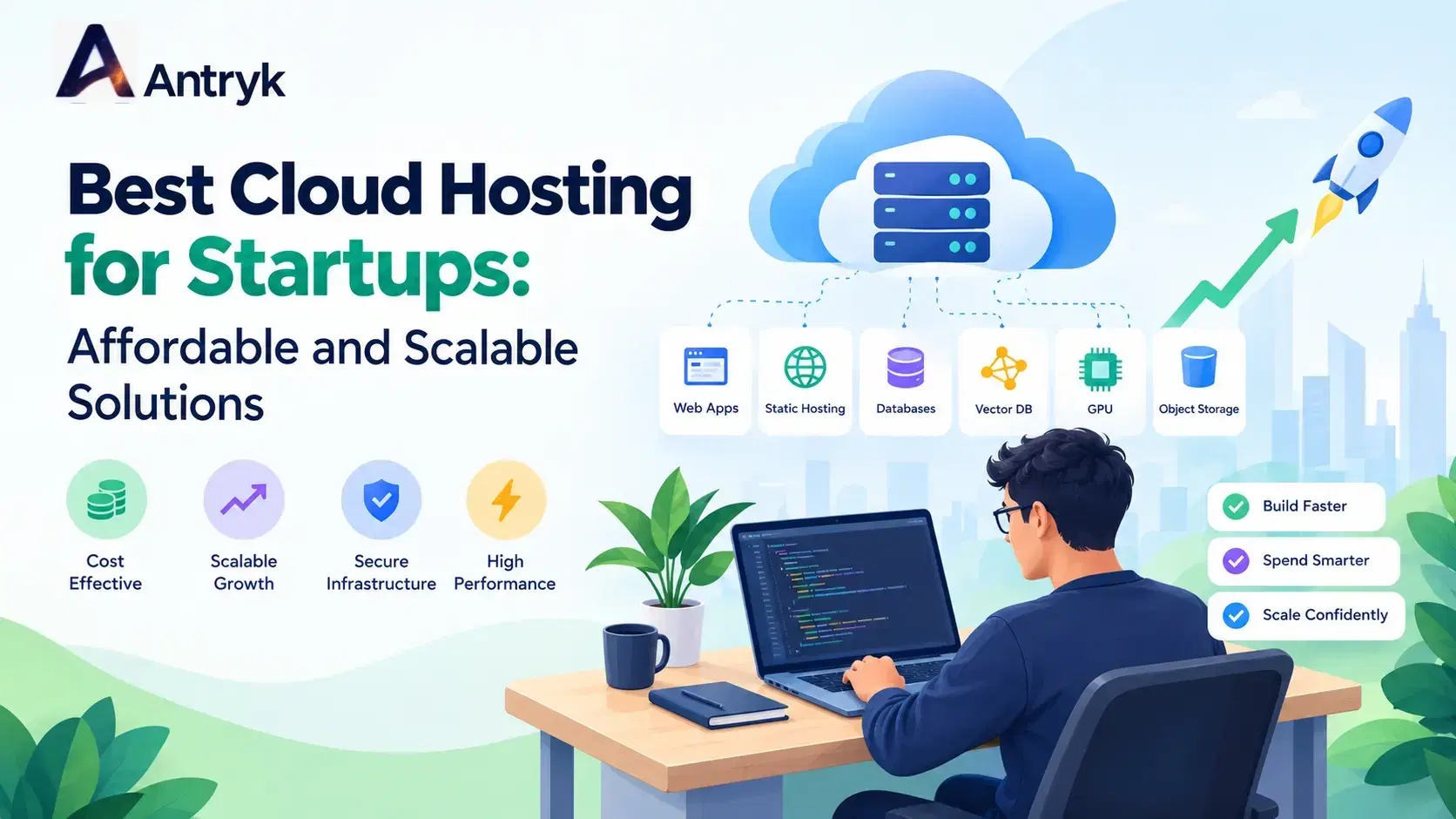
Antryk provides a cloud platform with multiple infrastructure services available through a shared dashboard and consolidated billing approach. Its offerings include web application hosting, static hosting, managed databases, vector databases, GPU workloads, and object storage. Explore Antryk's cloud pricing.
For startups, having access to several infrastructure categories through one platform can simplify service selection and make it easier to manage different components of an application.
Web Application Hosting for Startup Products#
Antryk's web services support backend APIs, microservices, and web applications, with features including Git-based auto-deployment, autoscaling, smart rollback, and uptime monitoring.
These capabilities can help development teams streamline deployment and application management.
Static Hosting for Marketing Websites#
Antryk offers static hosting starting at $0 per month, according to its published pricing page. The service includes a global CDN, SSL, and Git-based deployment features.
This can be relevant for startups launching landing pages, product documentation, or frontend projects. Actual suitability depends on the project's requirements and applicable plan limits.
Managed Databases for Application Data#
Antryk lists managed PostgreSQL, MySQL, Redis, and InfluxDB services, with published starting prices of $5.99 per month. Its pricing information describes features including automated backups, point-in-time recovery, and TLS encryption.
Startups can evaluate these options according to their data storage, querying, and application architecture needs.
Vector Databases and GPU Infrastructure for AI Startups#
Antryk offers managed Milvus, Qdrant, Chroma, and Weaviate vector databases, with published pricing starting at $5.99 per month.
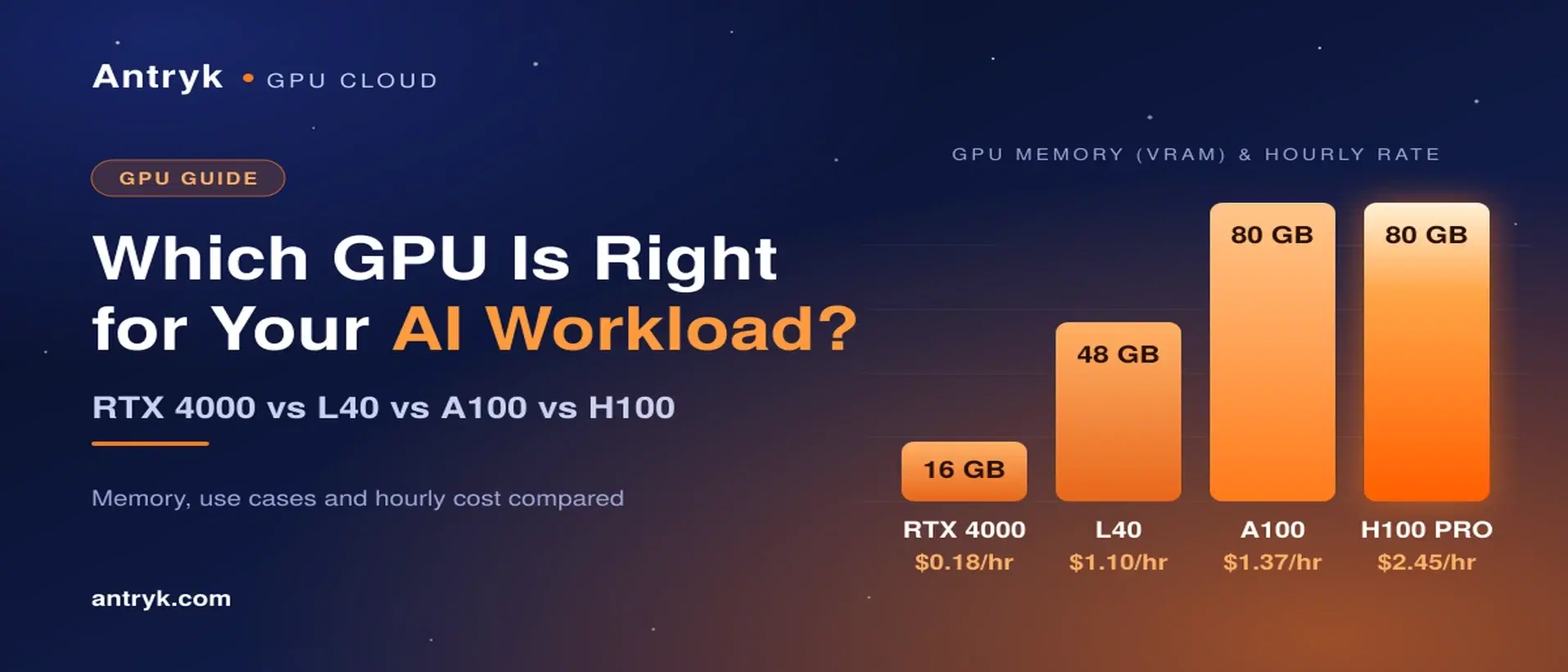
Its GPU workloads are listed from $0.18 per hour, with hibernation available for workloads that do not need to run continuously. Review the applicable GPU configuration, standby charges, and service terms before estimating total costs.
These services may be useful for teams developing AI-powered products, RAG applications, and machine learning workflows.
Understand the Pricing Before You Deploy#
Antryk's pricing page describes hourly billing for several services and states that it does not charge bandwidth fees. Its combined plan is listed from $55 per month.
Because costs depend on the specific services and resources selected, review the current pricing details and any applicable limits before deploying a production workload.
Visit the Antryk pricing page to compare the available services and choose a configuration aligned with your startup's requirements.
Common Cloud Hosting Mistakes Startups Should Avoid#
Even a well-priced hosting plan can become expensive or unsuitable if it is configured incorrectly.
Choosing only by starting price: A low entry price does not guarantee that the plan has enough memory, storage, or performance for your application.
Overprovisioning too early: Buying resources for hypothetical future traffic can increase costs without providing immediate value.
Ignoring operational requirements: Backups, monitoring, access controls, and recovery procedures are essential considerations, not optional extras.
Underestimating growth: A hosting solution should provide a practical upgrade path as your user base and application complexity increase.
Failing to review invoices: Regular cost reviews help identify idle services, unexpected usage, and opportunities to improve efficiency.
Avoiding these mistakes can help your startup maintain a more predictable infrastructure budget while preparing for growth.
Frequently Asked Questions About Cloud Hosting for Startups#
What Is the Best Cloud Hosting for Startups?#
The best option depends on your application, technical expertise, budget, and growth plans. Compare total costs, scalability, security features, deployment tools, and support before choosing a provider.
How Much Should a Startup Spend on Cloud Hosting?#
There is no single budget that suits every startup. A simple website may require minimal hosting, while a SaaS or AI application may need several services. Estimate costs based on your architecture, usage, and performance requirements.
Is Cloud Hosting Suitable for Small Startups?#
Yes. Cloud hosting allows small teams to use managed services and adjust resources as needed, without purchasing and maintaining physical servers.
Can Cloud Hosting Scale as a Startup Grows?#
Many cloud platforms allow resources to be upgraded or workloads to be distributed across multiple services. However, effective scaling also requires application architecture, database optimization, monitoring, and testing.
Is Managed Cloud Hosting Better for Startups?#
Managed hosting can reduce operational work for small teams. Self-managed infrastructure may offer more control, but it generally requires additional technical expertise and maintenance.
Which Cloud Hosting Is Best for AI Startups?#
AI startups should evaluate GPU availability, inference or training requirements, vector database support, storage, data transfer costs, and deployment flexibility. The best choice depends on whether the workload involves model training, inference, RAG, or other AI tasks.
Final Thoughts#
Choosing the best cloud hosting for startups means finding the right balance between affordability, performance, scalability, and operational simplicity.
Start by identifying your application's essential requirements, compare the complete cost of the infrastructure you need, and choose a platform that lets you expand without unnecessary complexity.
For early-stage businesses, transparent pricing and developer-friendly deployment workflows can help teams spend less time managing infrastructure and more time improving their products.
Antryk brings several cloud infrastructure services together in one platform, giving startups options for web applications, static websites, databases, vector search, GPU workloads, and object storage.
Ready to plan your startup's infrastructure? Explore Antryk's cloud hosting and pricing options to find services that fit your project's current requirements and future plans.
Build with what you need today, and scale when your business is ready.