 ntryk
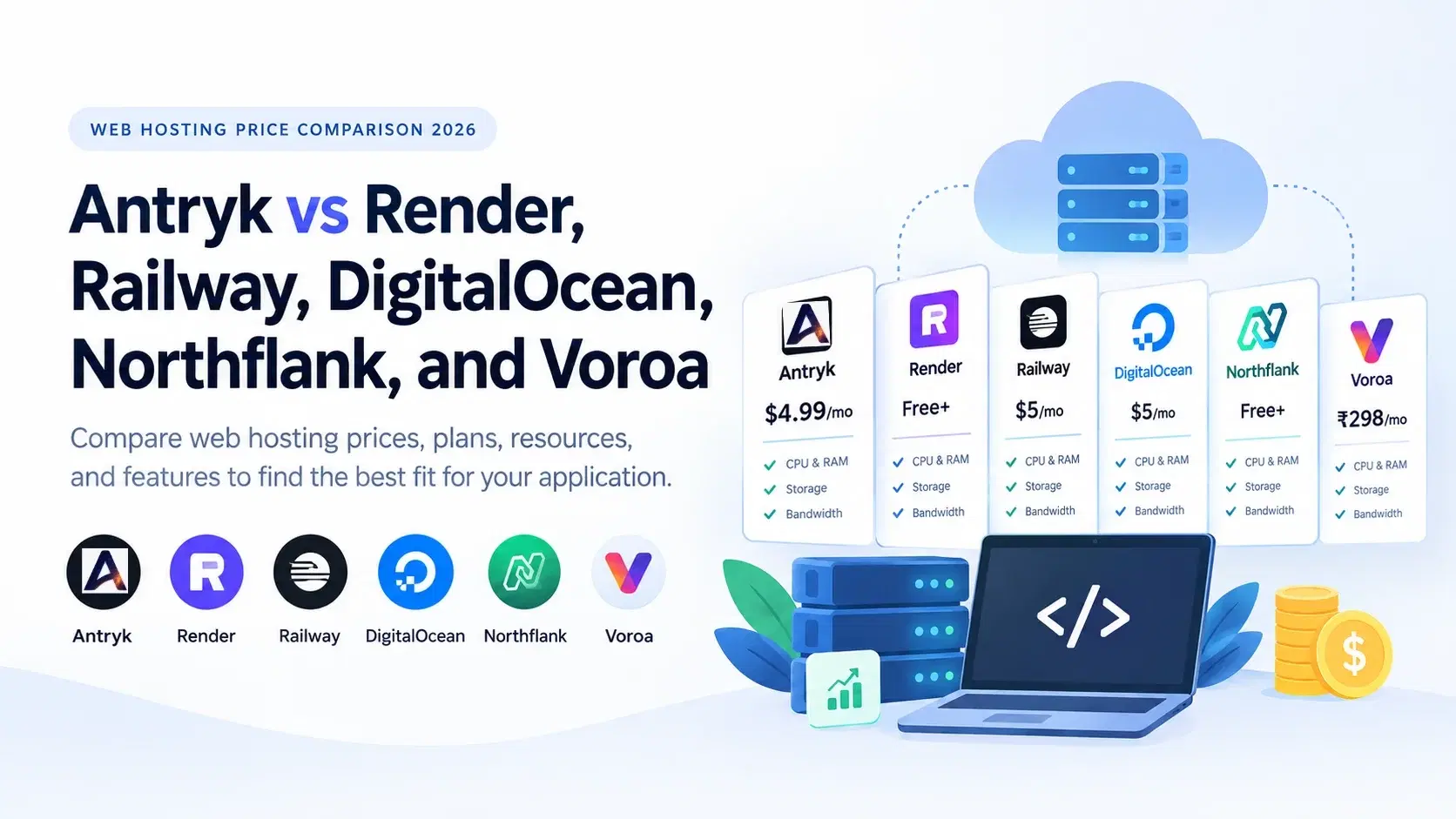
Web Hosting Price Comparison 2026: Antryk vs Render, Railway, DigitalOcean, Northflank, and Voroa#
Choosing a hosting platform is about more than finding the lowest advertised price. Developers need to consider computing resources, bandwidth, storage, deployment tools, scaling options, and the additional costs that may appear as an application grows.
In 2026, web hosting price varies significantly depending on the type of application you want to run. A personal project may work well on a free tier, while a production API, SaaS platform, or backend service may require dedicated resources and more predictable billing.
Platforms such as Antryk, Render, Railway, DigitalOcean App Platform, Northflank, and Voroa offer different approaches to application hosting. Some provide fixed monthly resource plans, others calculate bills based on usage, and some combine a workspace subscription with individual service costs.
This guide compares their pricing models, entry-level options, resource allocations, and important features to help you choose a suitable web hosting plan for your needs.
What Factors Affect Web Hosting Price?#
The total web hosting price depends on the resources your application consumes and the services included in your plan. Understanding these factors helps you compare providers accurately.
CPU and RAM Resources#
CPU determines how much processing capacity an application can use, while RAM supports running processes, application frameworks, and in-memory data. Small APIs and development projects may run comfortably on modest resources, whereas applications with heavy workloads may need more CPU and memory.
When comparing web hosting plans and prices, check both resource allocations rather than relying on the starting price alone.
Storage and Bandwidth#
Storage is used for application files, uploaded content, logs, and persistent data. Bandwidth refers to the data transferred between your application and its users or other services.
Some platforms include a monthly transfer allowance and charge for additional usage. Others advertise no bandwidth or egress fees. These differences can significantly affect the overall web hosting cost of a busy application.
Deployment and Management Features#
Automatic deployments, custom domains, managed SSL certificates, application logs, monitoring, rollbacks, and scaling tools can reduce the work required to maintain an application.
A plan with useful deployment features included may offer better value than a cheaper plan that requires separate services or additional configuration.
Fixed Pricing vs Usage-Based Billing#
Fixed monthly plans make budgeting easier because the selected resource tier has a published price. Usage-based platforms calculate charges according to the resources consumed, which can be useful for variable workloads.
The best pricing model depends on whether your application runs continuously, experiences traffic spikes, or needs resources only occasionally.
Web Hosting Price Comparison: Antryk vs Five Competitors#
The following comparison focuses on application and backend hosting rather than traditional shared hosting or static website hosting.
| Platform | Entry-level price or plan | Pricing model | Important consideration |
|---|---|---|---|
| Antryk | From $4.99/month | Hourly billing against plan pricing | No bandwidth or egress fees advertised |
| Render | Free tier available | Instance-based pricing | Check paid instance type and usage requirements |
| Railway | Free tier; Hobby at $5/month | Subscription credit applied to resource usage | CPU, RAM, storage, and network usage affect cost |
| DigitalOcean App Platform | Paid containers from $5/month | Fixed resource pricing | Includes a transfer allowance |
| Northflank | Free Sandbox; paid compute options | Resource-based pricing | Check compute, storage, and network charges |
| Voroa | Free Nano; paid web services from ₹298/month | Per-service compute plus workspace plan | INR billing; 18% GST applies |
Pricing reference date: October 23, 2026. These are starting prices or entry-level plan references, not necessarily equivalent production configurations. Check the linked official pricing pages before purchasing.
1. Antryk Web Service Hosting Pricing#
Antryk offers web service hosting for backend APIs, microservices, and web applications. Its published entry-level price starts at $4.99 per month, with hourly billing that allows charges to reflect how long a service runs.
The platform advertises Git-based automatic deployments, autoscaling, smart rollback, and built-in uptime monitoring. It also states that it does not charge bandwidth or egress fees.
This approach may appeal to developers who want a straightforward way to deploy applications without managing every part of the underlying infrastructure.
What to consider:
Published resource tiers for different application sizes.
Hourly billing rather than automatically paying for an entire month when a service is deleted early.
Deployment and monitoring features included in the platform.
No advertised bandwidth or egress charges.
Review the available CPU, RAM, storage, and service requirements before choosing a plan.
Explore Antryk Web Service Pricing for the current plans and resource specifications.
2. Render Web Service Pricing#
Render is a managed cloud platform for deploying web applications, APIs, background workers, and other services. It offers a free option for eligible workloads and paid services with different resource allocations.
Its instance-based model lets developers select an appropriate service size. The final web hosting price depends on the instance selected and any additional services required by the application.
Render may be suitable for developers who want managed deployments and a platform that supports applications from development through production.
What to consider:
The limitations of free services.
The cost of the selected paid instance.
Whether persistent disks or additional services are needed.
How the selected plan supports production workloads.
A free tier is useful for experimentation, but it should not automatically be treated as equivalent to a paid, always-on production service.
See Render Pricing for current instance rates and plan conditions.
3. Railway Hosting Pricing#
Railway uses a subscription-plus-usage model. Its published plans include Free at $0, Hobby at $5 per month, and Pro at $20 per month, with subscription fees applied toward resource consumption.
The platform measures resources such as CPU, RAM, storage, and network egress. Its published resource rates include $20 per vCPU per month, $10 per GB of RAM per month, $0.15 per GB per month for volume storage, and $0.05 per GB for network egress.
These rates make it important to estimate actual consumption instead of comparing only the subscription fee.
What to consider:
The monthly plan minimum and included usage credit.
CPU and memory consumption while services run.
Storage requirements and outbound data transfer.
The difference between experimentation and production usage.
Railway can be convenient for developers who prefer a usage-based approach, particularly when they monitor consumption and understand their application's resource requirements.
Check Railway Pricing and its pricing documentation for current rates and billing rules.4. DigitalOcean App Platform Pricing
DigitalOcean App Platform provides managed hosting for web applications, APIs, workers, and related components. Its published paid container pricing starts at $5 per month for a fixed shared option with 1 vCPU, 512 MiB RAM, and 50 GiB of transfer.
Larger options cost more. For example, the published shared-container options include 1 vCPU with 1 GiB RAM at $12 per month and 1 vCPU with 2 GiB RAM at $25 per month. Additional outbound transfer beyond the applicable allowance is charged separately.
DigitalOcean also provides free static-site hosting, but this should not be confused with free dynamic web-service hosting.
What to consider:
Fixed monthly container pricing.
Included outbound transfer and overage rates.
Additional database or dedicated IP costs.
Whether the selected configuration supports your application's scaling needs.
DigitalOcean can be a good option for teams that prefer published resource prices and a managed deployment environment.
See DigitalOcean App Platform Pricing for current plan details.
5. Northflank Hosting Pricing#
Northflank provides a platform for deploying applications, services, jobs, and supporting infrastructure. It offers a free Sandbox for eligible development workloads, while paid compute options are priced according to the selected resources.
When comparing Northflank with other hosting providers, look at the CPU and memory allocated to the service, along with storage, networking, and any additional infrastructure components.
A free development environment can help test an application before launch. However, a production deployment may require a different resource configuration and additional services.
What to consider:
Free Sandbox limits and service allowances.
CPU and RAM requirements for each workload.
Persistent storage and network usage.
The costs of running multiple services or production environments.
Northflank may suit teams that need more control over application infrastructure and deployment workflows.
Review Northflank Pricing to calculate the cost of your intended configuration.
6. Voroa Web Service Pricing#
Voroa provides web-service hosting with pricing displayed in Indian rupees. Its pricing structure separates workspace plans from the compute size selected for each service.
The published Nano web-service option costs ₹0 per month and provides 0.1 CPU with 512 MB RAM. The Starter option costs ₹298 per month for 1 CPU and 1 GB RAM, while Standard costs ₹498 per month for 1 CPU and 2 GB RAM.
Prices exclude 18% GST. The workspace plan also determines allowances such as the number of services, included bandwidth, build minutes, and team features.
This structure is particularly relevant for developers and businesses in India who prefer INR billing and local payment methods.
What to consider:
Workspace subscription requirements.
Per-service compute costs.
Included bandwidth and additional transfer or storage charges.
GST and the final payable amount.
Voroa can be attractive for users who want local-currency pricing, but remember to compare the full workspace and compute bill rather than the compute price alone.
Visit Voroa Pricing for the current workspace plans, service sizes, and terms.
Web Hosting Plans and Prices Compared Side by Side#
The following table highlights the main differences between the providers. Starting prices are useful for shortlisting options, but resource allocations and billing rules determine which plan offers the best value.
| Provider | Starting price reference | Billing approach | Bandwidth policy |
|---|---|---|---|
| Antryk | $4.99/month | Hourly billing | No bandwidth or egress fees advertised |
| Render | Free tier available | Based on selected service instance | Check plan-specific allowances and terms |
| Railway | $5/month Hobby | Usage credit plus resource charges | Egress billed by usage |
| DigitalOcean App Platform | $5/month | Fixed container price | Included transfer allowance; overages may apply |
| Northflank | Free Sandbox available | Resource-based | Check applicable network rates |
| Voroa | ₹0 Nano compute | Workspace plan plus per-service compute | Workspace bandwidth allowance applies |
How to Compare Prices Fairly#
When comparing web hosting price, use a consistent workload wherever possible. For example, compare services with similar CPU and RAM allocations, similar storage needs, and equivalent availability requirements.
A plan with 512 MB RAM should not automatically be compared with a plan that includes 2 GB RAM as if they offered the same capacity. Likewise, a static-site free tier is not an equivalent replacement for an always-on backend API.
Check the total cost of running the service for a full month, including any workspace fees, bandwidth charges, storage, databases, and other required services.
Fixed Pricing vs Usage-Based Web Hosting#
The right billing model depends on how your application behaves.
Benefits of Fixed Monthly Pricing#
Fixed monthly pricing makes it easier to budget for applications that run continuously. You select a resource configuration and know the published base price, subject to additional charges and plan conditions.
This can work well for small businesses, APIs, and applications with relatively consistent resource needs.
Benefits of Usage-Based Pricing#
Usage-based billing ties charges to resource consumption or active runtime. It can be useful for temporary workloads, development environments, and applications whose usage changes significantly throughout the month.
However, variable consumption can make bills harder to forecast. Monitoring usage and setting cost alerts, where available, can help avoid unexpected charges.
Which Model Is Better?#
Neither model is universally better. A fixed resource plan can simplify budgeting, while usage-based billing can be more flexible for variable workloads. Compare the complete billing rules before choosing a provider.
How to Choose the Best Web Hosting Price for Your Application#
Before purchasing a plan, identify what you are hosting and how it will be used.
For Personal Projects and MVPs#
A free tier or small entry-level plan may be sufficient for a prototype, test API, or early-stage product. Check sleep behaviour, usage restrictions, and resource limits before relying on a free option.
For APIs and Backend Services#
Prioritize reliable runtime capacity, sufficient memory, secure connections, deployment automation, and clear bandwidth policies. A low starting price may not be the best value if the application frequently exceeds its resource limits.
For Growing SaaS Applications#
Consider scaling options, monitoring, rollback functionality, persistent storage, and the cost of running multiple services. Calculate the cost of a realistic production configuration rather than focusing only on the smallest plan.
Why Consider Antryk for Web Service Hosting?#
Antryk offers a developer-focused option for hosting web applications, APIs, and microservices. Its published web-service plans start at $4.99 per month, and the platform describes an hourly billing model that adjusts charges to the time a service runs.
Its advertised features include Git auto-deployment, autoscaling, smart rollback, and built-in uptime monitoring. Antryk also states that it does not charge bandwidth or egress fees.
For developers who want to evaluate their hosting options, the most useful approach is to compare Antryk's resource tiers against alternatives with similar CPU, RAM, and workload requirements.
Review the Antryk Web Service Pricing page to check the available configurations and choose a plan based on your application's needs.
Frequently Asked Questions About Web Hosting Price#
What Is the Average Web Hosting Price Per Month in 2026?#
There is no single average that applies to every hosting type. Basic application-hosting options can start at a few dollars per month, while larger production configurations cost more depending on CPU, RAM, storage, traffic, and management requirements.
Which Web Hosting Provider Is the Cheapest?#
The cheapest option depends on the workload, location, resources, and billing conditions. Voroa offers a free Nano compute size, while Antryk and DigitalOcean publish entry-level paid options at $4.99 and $5 per month respectively. These plans do not provide identical resources or billing terms.
Is Fixed-Priced Hosting Better Than Usage-Based Hosting?#
Fixed pricing can make monthly budgeting easier. Usage-based billing can be useful when resource consumption changes frequently. Compare your application's expected usage and the provider's full billing rules before deciding.
What Is Included in a Web Hosting Plan?#
Depending on the provider, a plan may include compute resources, deployment tools, HTTPS, custom domains, logs, monitoring, and a defined amount of data transfer. Always check which features are included and which are charged separately.
Are There Additional Costs Beyond the Monthly Hosting Price?#
Potential extra costs include bandwidth overages, storage, databases, additional services, workspace subscriptions, dedicated IPs, and applicable taxes. Some providers advertise no bandwidth fees, while others include a transfer allowance and charge for excess usage.
How Much CPU and RAM Does a Web Application Need?#
Requirements depend on the framework, dependencies, traffic, and workload. A small API may work with limited resources, while a data-heavy application or a service with many concurrent requests may need more CPU and RAM. Monitor real usage and resize as necessary.
Conclusion: Find the Right Web Hosting Price in 2026#
The best web hosting price is not necessarily the lowest number on a pricing page. It is the price that gives your application enough resources, suitable deployment features, and a billing model that fits your workload.
Antryk emphasizes hourly billing and no bandwidth fees. Render and Northflank provide managed application deployment options, Railway uses subscription credits against resource consumption, DigitalOcean offers fixed container pricing with transfer allowances, and Voroa provides INR-based workspace and compute pricing.
Compare equivalent resources, read the conditions behind free tiers, and account for storage, bandwidth, and additional services before making your decision.
If you are looking for a platform for APIs, microservices, or web applications, explore Antryk Web Service Pricing to review its current plans and find an option that matches your requirements.