ntryk
ntryk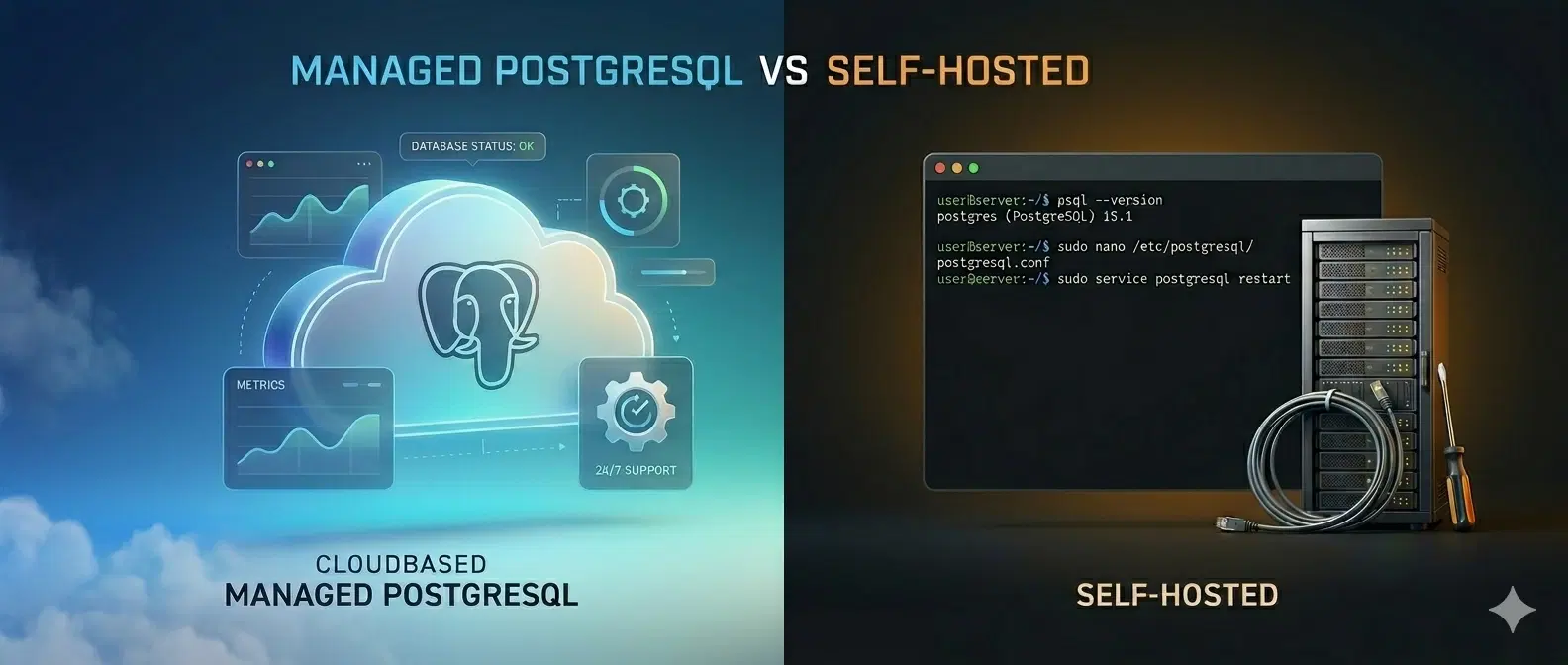
Managed PostgreSQL vs Self-Hosted: What Every Startup Should Know Before Choosing#
There's a moment every startup hits, usually somewhere between "okay the MVP works" and "we have actual users now," where someone asks: should we just manage the database ourselves?
It seems like the cheaper move. You already have a server. Postgres is free. How hard can it be?
The honest answer is: not that hard at first, and surprisingly painful later. This guide walks through what both options actually look like in practice - not in theory - so you can make a decision you won't regret six months down the road.
What "self-hosted PostgreSQL" actually means in practice#
Self-hosting Postgres isn't just running apt install postgresql and calling it done. Once your database holds real production data, you own a list of responsibilities that compounds over time.
You're responsible for:
Provisioning — picking the right server size, disk type, and OS configuration
Backups — setting up
pg_dumpor WAL archiving, testing restores, scheduling cron jobsPatching — applying minor and major version upgrades (major upgrades like Postgres 16 → 17 require
pg_upgradeor logical replication, usually with planned downtime)Monitoring — building or buying visibility into query performance, slow logs, disk usage
High availability — if your database goes down, so does your app. HA setups require a standby replica and a failover mechanism like Patroni
Security — TLS configuration, network access controls, credential rotation
None of this is rocket science. But it adds up. A senior engineer spending even 5–6 hours a week on database operations — at typical fully loaded engineering costs — can easily cost more than a managed plan ever would.
What managed PostgreSQL actually gives you#
A managed Postgres service handles all of the above for a flat monthly fee. You get:
A database that's running when you wake up
Automated daily backups you don't have to think about
Point-in-time recovery if something goes wrong
Version upgrades handled by the provider
Monitoring dashboards out of the box
Scaling options without re-architecting anything
The tradeoff is cost and, at large scale, some loss of fine-grained control. You can't tune shared_buffers or install arbitrary extensions on every managed platform. But for most early-stage startups, those constraints don't matter yet.
The real cost comparison (and what people miss)#
The sticker price of a managed plan looks high next to a $10/month VPS. But the comparison isn't apples-to-apples.
Self-hosted hidden costs:
Engineering time for setup, maintenance, and incidents
Separate monitoring tools (or the time to build your own)
Backup storage costs that add up with data growth
The cost of a production outage while someone fixes the database at 11 PM
Managed plan what you actually get:
Compute, storage, backups, TLS, and monitoring — in one bill
No surprise bandwidth or IOPS charges
No 2 AM pages because your replica fell out of sync
For a team of 1-5 people who need to ship product, the math usually favors managed. Not because self-hosting is wrong, but because the real cost of self-hosting is mostly paid in engineering time, not cash.
The break-even point: Self-hosted starts making financial sense when your managed database bill crosses ~$150–200/month and you have someone on the team who genuinely enjoys database operations. Before that threshold, managed almost always wins on total cost of ownership.
When self-hosted actually makes sense#
Let's be fair - there are legitimate reasons to self-host.
You should consider self-hosting if:
Your team has a dedicated DevOps and database engineer
You need extensions or configurations that managed platforms don't support
You're processing data at a scale where managed pricing becomes genuinely painful (think: thousands of GB with heavy write throughput)
You have compliance requirements that mandate on-premise or specific jurisdiction control
You've already validated product-market fit and are optimizing for efficiency
The key word is "already." Self-hosting is an optimization decision. It's not the right default for teams still figuring out what they're building.
When managed PostgreSQL is the obvious choice#
Go managed if:
You're at the MVP or early traction stage
Your team is focused on shipping features, not managing infrastructure
You don't have database operations experience on the team
You want predictable monthly costs with no surprise incidents
You need reliable backups and point-in-time recovery without building it yourself
At the early stage, your goal is validating your product - not maintaining infrastructure. A managed database with daily automated backups and connection pooling lets you focus entirely on your application.
A practical comparison table#
| Managed PostgreSQL | Self-Hosted | |
|---|---|---|
| Setup time | Minutes | Hours to days |
| Backups | Automatic, daily | You configure it |
| Point-in-time recovery | Included | Requires WAL archiving setup |
| Monitoring | Built-in dashboard | Build or buy separately |
| Major version upgrades | Provider handles | You run pg_upgrade |
| High availability | Toggle in dashboard | Patroni + replica setup |
| Monthly cost (small) | $5–30/mo (see Antryk pricing) | $10–32/mo server + your time |
| Who it's for | Teams focused on shipping | Teams with ops expertise |
What most startup founders get wrong#
The most common mistake isn't choosing the wrong option - it's choosing self-hosted to save money, then realizing that the savings disappear the first time something breaks.
A production database incident on a self-hosted setup can cost hours of engineering time, plus downtime your users notice. The "savings" evaporate quickly.
The second mistake is choosing a managed provider and then overpaying because they're using a hyperscaler (AWS RDS, Google Cloud SQL) when a simpler, more affordable managed platform does the same job for a fraction of the price.
What to look for in a managed PostgreSQL provider#
Not all managed Postgres is created equal. When evaluating options, check for:
Automated daily backups - and whether restores are self-serve or require a support ticket
Point-in-time recovery - critical if your app has active writes and you need fine-grained rollback
Connection pooling - important for apps with many concurrent connections (ORMs like Prisma and SQLAlchemy can exhaust Postgres connection limits fast)
Query insights - slow query logs and performance dashboards save hours of debugging
Horizontal and vertical scaling - can you grow without migrating to a new instance?
Transparent pricing - no egress surprises, no hidden IOPS charges
If you want all of this without stitching together three separate services, Antryk offers fully managed PostgreSQL, MySQL, and Redis - with automated backups, point-in-time recovery, connection pooling, and query insights - as part of a single unified cloud platform. It's built for exactly the kind of team that wants to spend time shipping, not maintaining. No separate billing for backups, no dashboard juggling.
The staged approach most growing startups use#
Here's what the practical arc looks like for most startups:
- 1
Pre-launch / MVP - Start with a managed plan. Lowest tier, single node. Focus entirely on building.
- 2
Early traction (first users) - Stay managed. Upgrade to a plan with daily backups and basic HA if you have paying customers.
- 3
Growth stage - Evaluate whether your database bill has crossed the self-hosting break-even. If it has, and you've hired someone with ops experience, consider it. If not, stay managed and optimize your queries instead.
- 4
Scale - Some teams move to self-hosted at scale. Many don't. Plenty of successful SaaS companies run managed databases at millions of users.
There's no shame in staying managed. The point of infrastructure is to support your product, not to become a side project.
Bottom line#
If you're an early-stage startup and you're asking this question, the answer is almost certainly managed PostgreSQL.
Not forever. Not at any price. But right now, while you're finding your users and shipping features, the last thing you want is a database incident eating your weekend.
Self-hosting is a valid choice - for teams with the experience and scale to make it worthwhile. For everyone else, a good managed provider with solid backups and connection pooling is just the right tool for the job.
Pick the thing that lets you focus on your product. The database can come later.
Priyanka K
Cloud Infrastructure Engineer
Priyanka has a background in backend engineering and cloud infrastructure. She's spent the last five years helping early-stage startups make smarter infrastructure decisions — without overcomplicating things. When she's not writing, she's probably arguing about database indexing strategies or breaking something in a staging environment. She believes good infrastructure should be invisible, and your weekend should stay yours.