 ntryk
Antryk vs Aiven: Managed Database Pricing, Features, and Performance Compared (2026)#
Choosing a managed database provider is an important decision for startups, SaaS businesses, and development teams. Your database stores critical application information, including customer records, transactions, product data, and business operations. The right provider should offer reliable infrastructure, appropriate security, backup and recovery options, predictable pricing, and enough flexibility to support future growth.
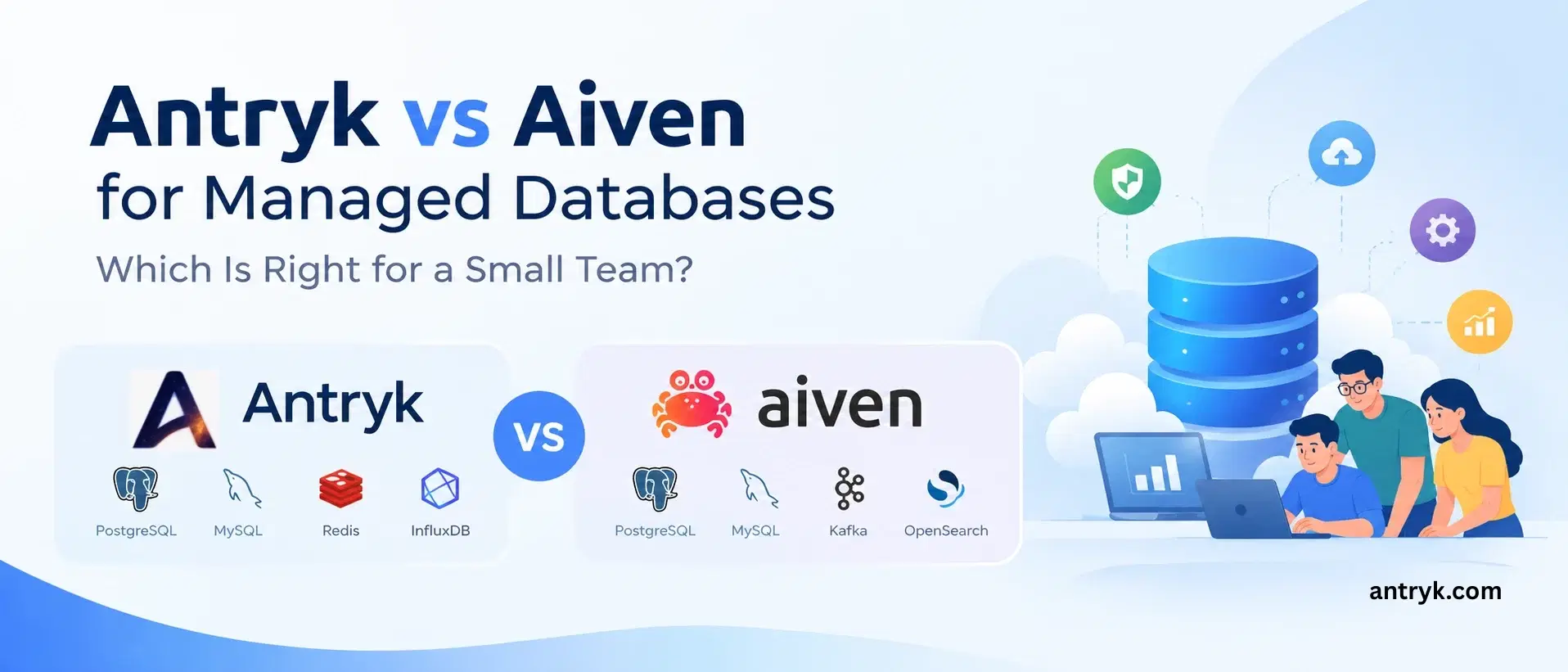
Two platforms worth evaluating are Antryk and Aiven. Both provide managed database services, but they approach pricing, infrastructure, database choices, and scalability differently.
Antryk focuses on providing managed databases alongside other cloud services through one platform. Its managed database pricing starts at $5.99 per month, with hourly credit deduction. Aiven offers managed PostgreSQL and MySQL, including free and paid entry-level plans, as well as a broader ecosystem of managed open-source data services.
However, comparing providers based only on their advertised starting prices can be misleading. A $5 database plan may have different storage, CPU, memory, backup, and availability capabilities from a $5.99 plan.
In this guide, we compare Antryk vs Aiven across managed database pricing, PostgreSQL, MySQL, Redis, infrastructure, backup and recovery, scalability, security, and operational costs. We also explain which platform may suit different types of development teams.
The objective is simple: help you choose a managed database provider based on your application's requirements and budget rather than marketing claims.
What Are Managed Database Services?#
A managed database service allows developers to use a database without handling every infrastructure and maintenance responsibility themselves.
With a self-managed database, your team may need to:
Provision and configure servers.
Install database software and dependencies.
Manage database upgrades and security patches.
Configure network access and encryption.
Monitor CPU, memory, storage, and database performance.
Schedule backups and test restoration procedures.
Troubleshoot infrastructure failures.
A managed database provider takes responsibility for many of these operational activities. The exact responsibilities depend on the provider, database engine, and selected plan.
Why Do Small Teams Choose Managed Databases?#
Managed databases are useful for startups, SaaS businesses, independent developers, and small engineering teams because they reduce infrastructure management work.
Common advantages include:
1. Reduced maintenance: Developers spend less time maintaining database servers and more time building application features.
2. Easier deployment: Teams can provision database instances through a management dashboard or supported interface.
3. Backup and recovery: Managed backup features help protect application data against accidental changes and certain infrastructure failures.
4. Better operational visibility: Monitoring and performance information help developers identify resource limitations.
5. Flexible infrastructure: Teams can evaluate larger configurations as their applications grow.
However, managed database hosting does not eliminate every database responsibility. Developers must still optimize queries, manage access permissions, design efficient schemas, monitor application performance, and test recovery procedures.
Antryk vs Aiven: Quick Comparison#
The following table summarizes the publicly listed features and entry-level pricing available for comparison in November 2026.
| Feature | Antryk | Aiven |
|---|---|---|
| Managed database starting price | $5.99/month | Free plans and paid plans from $5/month |
| Billing model | Hourly credit deduction | Hourly billing, invoiced monthly |
| PostgreSQL | Listed | Available |
| MySQL | Listed | Available |
| Redis | Listed | Valkey available in its broader ecosystem |
| InfluxDB | Listed on pricing overview; confirm current product availability | Not included in this PostgreSQL/MySQL comparison |
| Automated backups | Advertised as included | Available; plan-dependent details |
| Point-in-time recovery | Advertised as included | Available with plan-dependent recovery windows |
| Encryption | TLS encryption advertised | Encryption in transit and at rest |
| Free entry option | $10 trial credit | Free plans for selected services |
| Additional infrastructure | Web hosting, static hosting, GPU, storage, messaging and more | Managed data services across supported cloud providers |
| Best evaluation point | Hourly billing and multiple cloud services in one platform | Broader managed data ecosystem and cloud choices |
Important: This is a feature-level comparison, not a like-for-like performance benchmark. Confirm the exact database configuration, region, resource allocation, and plan limitations before purchasing.
1. Antryk vs Aiven: Managed Database Pricing Comparison#
Database hosting costs can become a significant part of a startup's monthly infrastructure budget. The challenge is that providers may advertise similar starting prices while including different amounts of storage, memory, CPU resources, backup retention, and production features.
For a fair comparison, it is important to distinguish advertised starting prices from the actual cost of running your application.
Antryk Managed Database Pricing#
Antryk lists managed databases starting at $5.99 per month.
Its pricing model uses hourly credit deduction. Customers are charged for the hours a service remains active rather than automatically paying for a complete calendar month when a service is deleted partway through the month.
Antryk lists the following managed database options:
PostgreSQL
MySQL
Redis
InfluxDB (listed in its pricing overview; verify current availability in the product documentation)
The platform also advertises automated backups, point-in-time recovery, and TLS encryption.
You can explore its current plans here:
Antryk Managed Database Pricing
For small development teams, hourly billing may be useful when:
You operate development or testing environments that do not need to run continuously.
You want to evaluate an application before committing to a larger configuration.
You need to manage infrastructure usage around development schedules.
You are considering multiple cloud services under one platform.
What should you check before choosing an Antryk plan?
Do not assume the $5.99 starting price includes every resource or feature you might need. Check the plan's CPU, RAM, storage, database engine, backup retention, recovery capabilities, and regional availability.
Also distinguish between the advertised monthly equivalent and your actual hourly credit consumption.
Aiven Managed Database Pricing#
Aiven provides free and paid managed database plans for selected services, including PostgreSQL and MySQL.
Its published MySQL pricing includes:
| Aiven MySQL Plan | Starting Price | CPU | RAM | Storage |
|---|---|---|---|---|
| Free | $0/month | 1 CPU | 1 GB | 1 GB |
| Developer | $5/month | 1 CPU | 1 GB | 8 GB |
| Hobbyist | $19/month | 1 CPU | 1 GB | 8 GB |
| Startup | $75/month | 2–32 CPUs | 4–192 GB | 80 GB–7.17 TB |
| Business | $180/month | 2–32 CPUs per VM | 4–192 GB per VM | 80 GB–7.17 TB |
| Premium | $270/month | 2–32 CPUs per VM | 4–192 GB per VM | 80 GB–7.17 TB |
These are advertised starting prices; actual costs depend on the selected cloud, region, and configuration.
For PostgreSQL, Aiven also publishes a $0 Free plan and a $5 Developer plan, with Hobbyist starting at $12 and Startup at $75.
Official pricing references:
Aiven's Free and Developer plans are useful for learning, development, and experimentation. However, they have limitations.
For example, the published MySQL Free and Developer plans do not allow specific cloud or region selection and do not include connection pooling. Their recovery provisions are also more limited than higher-tier production plans.
Which Provider Offers Better Pricing?#
There is no universal winner based on starting price alone.
Aiven offers a lower advertised entry point for developers who want a small database configuration or free access for experimentation.
Antryk's $5.99 starting price may be attractive to teams that prefer hourly credit deduction and want to evaluate multiple infrastructure services within one platform.
The important comparison is the cost of equivalent resources.
Before choosing, compare:
CPU and memory allocation.
Database storage capacity.
Backup frequency and retention.
Point-in-time recovery.
High-availability configuration.
Network and data-transfer costs.
Support availability.
Expected monthly running time.
A lower advertised price is useful only when the included resources satisfy your workload.
2. Database Options and Supported Workloads#
The database engine you choose should match your application's data model and performance requirements.
Antryk and Aiven both offer managed PostgreSQL and MySQL. Their broader data-service offerings differ.
PostgreSQL#
PostgreSQL is a popular open-source relational database used for SaaS applications, business software, analytics systems, and customer-facing platforms.
It supports structured data, complex queries, transactions, indexing, and a broad ecosystem of extensions.
Common PostgreSQL use cases include:
Customer accounts and authentication data.
Subscription and billing records.
E-commerce products and orders.
Inventory management.
Business dashboards and reporting.
Application configuration and permissions.
Both Antryk and Aiven offer managed PostgreSQL.
When comparing their PostgreSQL offerings, check supported versions, connection limits, extension availability, storage, backup retention, and recovery options.
A database provider should also make it clear whether a particular PostgreSQL configuration supports the connection patterns and extensions your application depends on.
MySQL#
MySQL is another widely used relational database, particularly for web applications, content-driven platforms, and applications built around established MySQL tooling.
Typical use cases include:
Website databases.
Customer management systems.
E-commerce applications.
Content management platforms.
Internal business applications.
Transaction-based applications.
Both Antryk and Aiven offer managed MySQL.
Aiven publishes separate PostgreSQL and MySQL pricing, so do not assume that both database engines have identical costs.
If your application already uses MySQL, compare database versions, compatibility, migration procedures, connection limits, and backup policies before switching providers.
Redis#
Redis is an in-memory data store commonly used for caching, session storage, real-time data access, queues, and pub/sub messaging.
For example, an e-commerce application may use PostgreSQL to store customer orders while Redis temporarily stores frequently accessed information.
Antryk lists managed Redis among its database offerings.
Aiven's broader managed-data ecosystem includes Valkey, an open-source Redis-compatible alternative.
Although Redis and Valkey have overlapping use cases, teams should check compatibility with their application, client libraries, commands, modules, and persistence requirements before selecting either service.
InfluxDB and Other Data Services#
InfluxDB is designed for time-series data, such as application metrics, sensor readings, monitoring information, and IoT measurements.
Antryk's overall pricing overview lists InfluxDB. Its current Products page highlights PostgreSQL, MySQL, and Redis in the managed database section. Confirm InfluxDB's current availability and support before treating it as a production-ready option.
Aiven offers a wider managed-data portfolio that includes services such as:
PostgreSQL
MySQL
Valkey
OpenSearch
Apache Kafka
ClickHouse
This makes Aiven relevant to teams building more complex data architectures that combine relational databases, search, caching, event streaming, and analytics.
Which platform is better for database variety?
If your application primarily needs PostgreSQL, MySQL, or Redis, compare the exact service configurations.
If you need a wider collection of managed data technologies, Aiven's broader ecosystem is worth evaluating.
If you want databases alongside application hosting, GPU workloads, storage, and messaging services, Antryk's wider platform may be useful.
3. Billing Models: Hourly Billing vs Monthly Pricing#
Billing flexibility is an important consideration for startups and small engineering teams.
A database may be used continuously in production but only during working hours in a development or testing environment.
Understanding how each provider calculates charges can help avoid unnecessary infrastructure spending.
How Antryk Billing Works#
Antryk advertises hourly credit deduction across its platform.
Its pricing information explains that customers pay for active service hours. If a service is deleted partway through the month, billing stops rather than automatically charging the full monthly amount.
This can help teams manage temporary environments and development infrastructure.
For example, a team testing a new application may run a database during development and remove the instance after testing is complete.
The actual charge depends on the plan's hourly rate and the number of active hours.
Antryk also advertises no bandwidth or data-egress fees across its platform. This is a useful distinction when estimating infrastructure costs, but teams should confirm any service-specific exclusions and applicable usage conditions.
How Aiven Billing Works#
Aiven uses hourly billing and invoices customers monthly.
The hourly price depends on the service, plan, cloud provider, region, and configuration.
Aiven's pricing documentation explains that the hourly rate includes the managed data service and its underlying cloud infrastructure, along with routine operational work.
Costs may change when customers:
Upgrade to a larger configuration.
Add additional services.
Increase storage.
Select a different plan.
Purchase additional support.
Use eligible BYOC configurations.
Aiven also provides a pricing calculator to estimate costs based on workload requirements.
Which Billing Model Is Better?#
Antryk may be worth considering if you prefer hourly credit deduction and want to manage several services through one platform.
Aiven may suit teams that want its managed data ecosystem and hourly service pricing with monthly invoicing.
Both providers offer hourly-based billing, so the difference should not be described simply as hourly versus monthly.
The better approach is to calculate the expected monthly cost for your actual database configuration and usage pattern.
4. Backup, Recovery, and Data Protection#
Database backups are essential for protecting application information.
Accidental deletion, application errors, failed updates, infrastructure problems, and data corruption can affect production databases.
A provider's backup feature is only useful when the backup can be restored successfully within an acceptable recovery period.
Backup Features on Antryk#
Antryk advertises automated daily database backups and point-in-time recovery as part of its managed database offering.
Its platform pricing overview also lists TLS encryption for managed databases.
Before deploying a production database, confirm:
The exact backup schedule.
How many days backups are retained.
Whether PITR is available for your chosen engine and plan.
How far back a database can be restored.
Whether restoration has additional charges.
How long a typical recovery operation takes.
These details should be confirmed from Antryk's current service documentation rather than assumed from the general feature list.
Backup and Recovery on Aiven#
Aiven advertises automated backups and point-in-time recovery, with recovery provisions depending on the selected plan.
Its published MySQL plan comparison lists:
Free: Single backup for disaster recovery.
Developer: Single backup for disaster recovery.
Hobbyist: Single backup for disaster recovery.
Startup: Two-day PITR window.
Business: Fourteen-day PITR window.
Premium: Thirty-day PITR window.
The exact recovery configuration should be checked for the database engine and plan you intend to purchase.
What Is Point-in-Time Recovery?#
Point-in-time recovery (PITR) allows a database to be restored to a selected point within an available recovery window.
For example, if an application accidentally modifies customer records, PITR may allow the team to restore the database to a point before the unwanted changes occurred.
The available recovery window matters.
A two-day recovery window and a thirty-day recovery window do not provide equivalent protection.
What Should Small Teams Prioritize?#
For a production database, evaluate:
- 1
Backup frequency.
- 2
Backup retention.
- 3
PITR availability.
- 4
Restore procedure.
- 5
Recovery time.
- 6
Data consistency after restoration.
Do not compare providers simply by checking whether both advertise automated backups.
A reliable backup strategy should also include regular restore testing and a documented recovery procedure.
5. Scalability and Database Performance#
As an application grows, its database workload changes.
More users can mean more concurrent connections, additional queries, larger datasets, and increased demand for memory and CPU resources.
Choosing a provider that supports your expected growth can reduce the need for an unplanned migration.
Scaling with Antryk#
Antryk's Products page advertises horizontal and vertical scaling for managed databases, along with connection pooling and query insights.
Vertical scaling generally involves increasing the resources assigned to a database, such as CPU, memory, or storage.
Horizontal scaling involves distributing workload across multiple database resources, depending on the database architecture.
However, the exact implementation is important.
For example, horizontal scaling might involve read replicas, distributed architecture, or another mechanism. These approaches are not interchangeable.
Before choosing an Antryk plan, confirm:
Which database engines support each scaling method.
Whether scaling is automatic or manual.
Whether scaling requires downtime.
Whether read replicas are available.
How connection pooling is configured.
Whether additional resources increase the hourly cost.
Antryk may be worth evaluating if its scaling options match your application's requirements and you want to manage other application infrastructure within the same platform.
Scaling with Aiven#
Aiven offers multiple service tiers with larger configurations for applications that need additional resources.
Its published MySQL plans include larger Startup, Business, and Premium configurations.
The Business plan adds high availability compared with Startup, while Premium adds a second standby node according to its published plan comparison.
Aiven also provides read-replica capabilities on eligible configurations.
These features can help teams design database infrastructure for larger production workloads.
However, high availability, larger compute configurations, and advanced recovery options can increase the monthly infrastructure cost.
How to Evaluate Database Performance#
Do not choose a database provider based only on claims about speed or scalability.
Measure the actual workload.
Useful performance indicators include:
Average query latency.
P95 and P99 query latency.
CPU utilization.
Memory utilization.
Database connection count.
Slow query frequency.
Disk utilization.
Transaction throughput.
Replication lag, where applicable.
Run tests using representative application queries and realistic data volumes.
A provider that performs well for a small test database may behave differently under production traffic.
6. Security and Infrastructure Management#
Database security is essential because databases often contain customer information, business records, credentials, and other sensitive application data.
Both providers advertise managed database infrastructure, but the security controls and configuration details should be compared carefully.
Antryk Security Features#
Antryk advertises TLS encryption for managed database connections.
Its wider platform also emphasizes centralized service management through one dashboard.
Before using Antryk for production workloads, confirm the available controls for:
Database authentication.
User and role management.
Network access restrictions.
Credential rotation.
Encryption in transit.
Encryption at rest, where applicable.
Audit logging.
Backup access and restoration permissions.
Do not assume that a general security feature applies identically to every database engine.
Aiven Security Features#
Aiven lists encryption in transit and at rest for its managed database services.
Its broader platform also provides managed infrastructure and operational capabilities, with cloud and regional choices varying by service and plan.
Teams with specific compliance or networking requirements should check the availability of VPC peering, private networking, access controls, support, and audit-related features for their chosen configuration.
Which Platform Should You Choose for Security?#
Neither provider should be selected based on a general statement that one is more secure.
Evaluate the specific controls your application requires and request documentation where necessary.
For regulated or business-critical workloads, also review data residency, compliance documentation, incident response procedures, and contractual service commitments.
7. Total Cost of Ownership: Beyond the Starting Price#
The monthly database charge is only one component of the total cost of ownership (TCO).
TCO includes direct infrastructure spending as well as the time developers spend maintaining the database.
Consider these cost factors:
| Cost Factor | Why It Matters |
|---|---|
| CPU and memory | Larger workloads need additional resources |
| Storage | Growing datasets may require upgrades |
| Backups | Retention and recovery features vary |
| High availability | Additional nodes can increase costs |
| Data transfer | Network and egress charges may apply |
| Support | Enhanced support may have separate pricing |
| Engineering time | Maintenance and troubleshooting consume developer hours |
| Migration | Moving databases requires planning and testing |
Antryk advertises hourly credit deduction and no bandwidth fees across its platform.
Aiven publishes hourly service pricing and includes its managed operational service in its plan pricing, with additional costs possible for changes such as larger configurations, storage, extra services, and upgraded support.
A fair TCO comparison should use the same expected workload and service requirements for both providers.
For example, a small development database and a production database with high availability should not be compared using the same starting-price assumptions.
8. Antryk vs Aiven: Which Is Better for Small Teams?#
The right provider depends on your application, infrastructure requirements, engineering experience, and budget.
Choose Antryk If:#
Antryk may be worth considering if your team:
Wants managed PostgreSQL, MySQL, or Redis.
Prefers hourly credit deduction for active services.
Wants to evaluate multiple infrastructure services through one platform.
Needs database hosting alongside web services, static hosting, GPU workloads, or storage.
Wants to compare infrastructure costs using its published starting plans.
Values a consolidated platform and billing experience.
Before making a production decision, verify the precise database resources, backup retention, recovery capabilities, and regional availability.
Explore the platform: Antryk
Choose Aiven If:#
Aiven may be worth considering if your team:
Wants to experiment with free managed database plans.
Needs PostgreSQL or MySQL with published configuration options.
Requires a wider managed-data ecosystem.
Wants cloud-provider and region choices on eligible plans.
Needs additional data services such as Kafka, OpenSearch, ClickHouse, or Valkey.
Requires production configurations with documented availability and recovery options.
Aiven's free and Developer plans are useful for experimentation and development. Production workloads should be evaluated against its higher-tier capacity, recovery, and availability features.
Explore the platform: Aiven
When Should You Consider Self-Managed Databases?#
Self-managed databases may be appropriate when your team has the technical expertise to configure and maintain database infrastructure.
They can offer greater control over the operating environment and configuration.
However, you must account for server maintenance, security patches, monitoring, backups, recovery, upgrades, and incident management.
For small teams without dedicated infrastructure engineers, managed databases may reduce operational complexity.
9. How to Choose the Right Managed Database Provider#
Before making your decision, follow this practical checklist.
Step 1: Identify your database engine.
Determine whether your application needs PostgreSQL, MySQL, Redis, or a specialized data service.
Step 2: Estimate your resource requirements.
Calculate the CPU, RAM, storage, and connection capacity your application needs.
Step 3: Compare equivalent plans.
Do not compare a small development instance with a production configuration that includes additional availability and recovery features.
Step 4: Review backup and recovery.
Check backup frequency, retention, PITR, and restoration procedures.
Step 5: Evaluate security.
Confirm encryption, network access, authentication, and credential management.
Step 6: Calculate the total cost.
Include compute, storage, data transfer, backups, support, and expected running hours.
Step 7: Test before migrating.
Run representative queries, test application compatibility, and verify the restore process before moving production data.
These steps help prevent unexpected costs and reduce the risk of choosing infrastructure that cannot support your application as it grows.
Frequently Asked Questions#
1. Is Antryk cheaper than Aiven?#
Antryk's managed database pricing starts at $5.99 per month. Aiven offers free plans for selected services and PostgreSQL and MySQL Developer plans starting at $5 per month. The included resources and features differ, so compare equivalent configurations before deciding.
2. Does Antryk support PostgreSQL and MySQL?#
Yes. Antryk lists PostgreSQL and MySQL as managed database options. Its pricing overview also lists Redis and InfluxDB. Confirm current availability and engine-specific features in the official product documentation.
3. Does Aiven offer free managed databases?#
Yes. Aiven offers free plans for selected services, including PostgreSQL and MySQL. These plans have limited CPU, RAM, storage, and other capabilities. They are useful for learning, testing, and prototypes but should not automatically be treated as production-ready alternatives.
4. Does Antryk provide hourly database billing?#
Yes. Antryk advertises hourly credit deduction for active managed database services. Charges depend on the active hours and selected configuration.
5. Does Aiven charge hourly or monthly?#
Aiven calculates service charges using hourly rates and invoices customers monthly. The hourly rate depends on the service, plan, cloud provider, region, and configuration.
6. Which platform supports PostgreSQL?#
Both Antryk and Aiven offer managed PostgreSQL. Compare supported versions, extensions, CPU, memory, storage, connection limits, backups, and recovery options before choosing.
7. Which provider is suitable for MySQL applications?#
Both providers offer managed MySQL. Aiven publishes separate MySQL plan pricing, while Antryk lists MySQL within its managed database services. Your choice should depend on the required configuration, pricing, compatibility, and operational features.
8. Does Aiven support databases other than PostgreSQL and MySQL?#
Yes. Aiven offers a broader managed-data ecosystem that includes Valkey, OpenSearch, Apache Kafka, ClickHouse, and other services.
9. Why are database backups important?#
Backups protect application data against accidental deletion, corruption, and certain infrastructure failures. A production database should have an appropriate backup schedule, retention period, recovery procedure, and regularly tested restoration process.
10. Can I migrate from Aiven to Antryk?#
Database migration may be possible when the target engine and database versions are compatible. Before migrating, review schema compatibility, extensions, users, permissions, connection settings, data volume, and downtime requirements. Test the migration in a non-production environment first.
11. Is a managed database better than a self-hosted database?#
A managed database can reduce infrastructure maintenance and operational responsibilities. A self-hosted database offers greater control but requires your team to manage provisioning, security, backups, monitoring, upgrades, and recovery.
12. What should startups consider before choosing a database provider?#
Startups should compare starting costs, CPU, memory, storage, backup retention, recovery options, connection limits, scalability, security, and support. Choose a configuration that meets current application requirements without paying for unnecessary capacity.
Final Verdict: Antryk vs Aiven#
Both Antryk and Aiven offer managed database services, but they are designed around different infrastructure priorities.
Antryk is worth evaluating if you want managed databases alongside application hosting, static hosting, GPU workloads, storage, and other cloud services through one platform. Its advertised $5.99 starting price and hourly credit deduction offer a pricing model worth comparing for smaller teams.
Aiven is worth evaluating if you want a broader managed-data ecosystem, free entry-level database options, and cloud-provider choices on eligible plans. Its tiered plans also provide documented options for larger production configurations and higher availability.
The best choice depends on your application's requirements, not just the starting price.
Compare the resources, billing model, backup policy, security features, and expected monthly cost before making your decision.
If your team is exploring managed databases for a startup, SaaS product, or web application, review Antryk's current database plans and evaluate whether its infrastructure fits your workload.
Explore Antryk Managed Databases:
https://www.antryk.com/pricing/databases
Build, deploy, and manage your application infrastructure with a platform that matches your team's requirements.